

THE CORTEX COLLECTIVE PHILOSOPHY
Why This Practice Exists
The Cortex Collective was not created from a single qualification, role or life experience. It emerged from the intersection of three perspectives that, over time, kept leading me back to the same observations and questions.
The first was my own lived neurodivergent experience.
Like many late-diagnosed neurodivergent adults, I spent years trying to understand why some aspects of life seemed to require significantly more effort than they appeared to for other people. Long before I had language for concepts such as masking, burnout, nervous system overwhelm or environmental mismatch, I was living them.
The second was education.
During sixteen years as a teacher, I worked with many students whose distress, differences and support needs were often viewed through behavioural, academic or compliance-based lenses. I became increasingly interested in what sat underneath the behaviours people could see, and why some students continued to struggle even when multiple supports and interventions were in place.
The third was counselling and neurodivergent support.
Throughout my seven years as a counsellor, alongside my own lived experience, I worked with many individuals who were struggling to adapt to environments that did not align with their nervous systems, communication styles, sensory needs or ways of processing the world. Over time, this can create a profound sense of disconnection from both themselves and others, alongside a growing belief that everyone around them somehow seems to "get life right" whilst they don't. For many, this develops into a looming sense of drowning; a feeling that they are somehow failing at things that appear effortless for everyone else, despite often working far harder than those around them realise.
At the same time, this is not the whole story.
Throughout my life and career, I have also seen immense creativity, insight, determination, humour, passion and innovative thinking that so often accompany neurodivergence. I have seen people notice patterns others miss, approach problems from entirely different angles and bring extraordinary depth, authenticity and curiosity to the world around them.
The purpose of this philosophy is not to portray neurodivergence as a collection of difficulties. Rather, it is to explore what can happen when strengths are repeatedly overlooked, misunderstood or forced to operate within environments that were never designed with them in mind.
I have also become increasingly aware of how often distress is misunderstood. Behaviour is frequently treated as the problem. The person becomes the problem.
The focus shifts to changing, managing or fixing the individual, while insufficient attention is given to the environments, expectations and systems surrounding them. Over time, this can create a profound sense of disconnection from both themselves and others, alongside a growing belief that everyone around them somehow seems to "get life right" whilst they don't. For many, this develops into a looming sense of drowning; a feeling that they are somehow failing at things that appear effortless for everyone else, despite often working far harder than those around them realise.
This philosophy was shaped by my growing belief that many of the struggles experienced by neurodivergent people cannot be fully understood in isolation from the context in which they occur.
What struck me most was how rarely the conversation began with curiosity. Instead, it so often focused on changing the person rather than understanding the context in which their difficulties were occurring.
Again and again, I found myself asking different questions.
What if the behaviour makes sense?
What if the distress is understandable?
What if the problem is not the person, but the environment they are being asked to function within?
From these experiences and questions, The Cortex Collective grew.
The ideas explored throughout these pages are not presented as universal truths. They are reflections shaped by lived experience, professional experience and years of observing what happens when neurodivergent people are genuinely understood — and what happens when they are not.
My hope is that these reflections offer a different lens through which to view neurodivergence, support and the human beings at the centre of both.
You may agree with some of these ideas and disagree with others. My intention is not to provide answers, but to encourage curiosity, reflection and perhaps a different way of looking at experiences that are often reduced to behaviour, diagnosis or deficit.
Beyond Behaviour
Behaviour Never Exists in Isolation
One of the patterns I have observed repeatedly throughout my career is how quickly behaviour becomes the focus.
A child is struggling to go to school.
A teenager is withdrawing.
An adult is overwhelmed, exhausted or struggling to cope.
The conversation often centres on what needs to change within the individual. The behaviour becomes the problem to solve.
Whilst behaviour can provide important information, I do not believe it can be fully understood in isolation from the context in which it occurs.
Looking Beyond the Individual
Too often, the focus becomes fixing the individual's behaviour without adequately examining whether the environment itself is compatible with that person's nervous system, sensory profile, communication style, capacity or support needs.
In many cases, distress is not occurring because the person is failing the environment, but because the environment is repeatedly failing the person.
This idea of environmental mismatch sits at the core of much of my thinking. Environmental mismatch occurs when people are expected to function within environments, systems or expectations that are fundamentally at odds with how their nervous system operates
Over time, maintaining that mismatch requires significant adaptation. People may learn to mask, become perfectionistic, prioritise the needs of others above their own or push themselves far beyond sustainable limits in an effort to cope. For many, the eventual result is burnout.
A nervous system experiencing chronic environmental mismatch will eventually show signs of distress, although that distress can look very different from one person to the next.
Behaviour Is Communication
I believe behaviour makes far more sense when it is viewed as communication rather than simply compliance or non-compliance. Behaviour often communicates what a person cannot yet express, does not have the words to explain, or may not fully understand themselves. It may communicate overwhelm, anxiety, sensory distress, uncertainty, fear, frustration, exhaustion or unmet needs. When behaviour is treated solely as something to be managed, reduced or eliminated, the message can be missed entirely.
The Cost of Environmental Mismatch
None of this means that expectations, boundaries, skill development or personal responsibility are unimportant. However, I believe meaningful support requires looking beyond behaviour alone and considering the broader relationship between the individual and the environments they are being asked to function within.
A person may be doing everything that is asked of them whilst paying an enormous internal cost.
Looking beyond behaviour creates space to better understand that cost, recognise environmental mismatch and identify supports that are more sustainable in the long term.
Understanding is Regulation
Making Sense Before Moving Forward
When people think about emotional regulation, they often think about strategies such as deep breathing, grounding, movement, mindfulness or sensory supports. These can all be incredibly valuable, and I regularly encourage clients to discover the approaches that work best for them.
Over the years, however, I have noticed something else.
For many of the neurodivergent people I have worked with (myself included), making sense of an experience can be regulating. Not because we are trying to intellectualise our emotions or because we are avoiding difficult feelings. Rather, understanding often reduces uncertainty, and uncertainty can be profoundly dysregulating.
Understanding Before Reassurance
For many of us, the instinctive response to another person's distress is reassurance.
"Everyone struggles with that."
"Everything will be okay."
"Try not to think about it."
These responses usually come from a place of genuine care. People naturally want to ease another person's distress as quickly as possible, and for a few people they may be genuinely comforting. For many others, however, reassurance alone does little to reduce the uncertainty driving the distress.
Making sense of an experience isn't about collecting more information for its own sake. It is about reducing the gap between what happened and what makes sense. Until that gap begins to close, many people remain stuck trying to resolve uncertainty rather than process the experience itself.
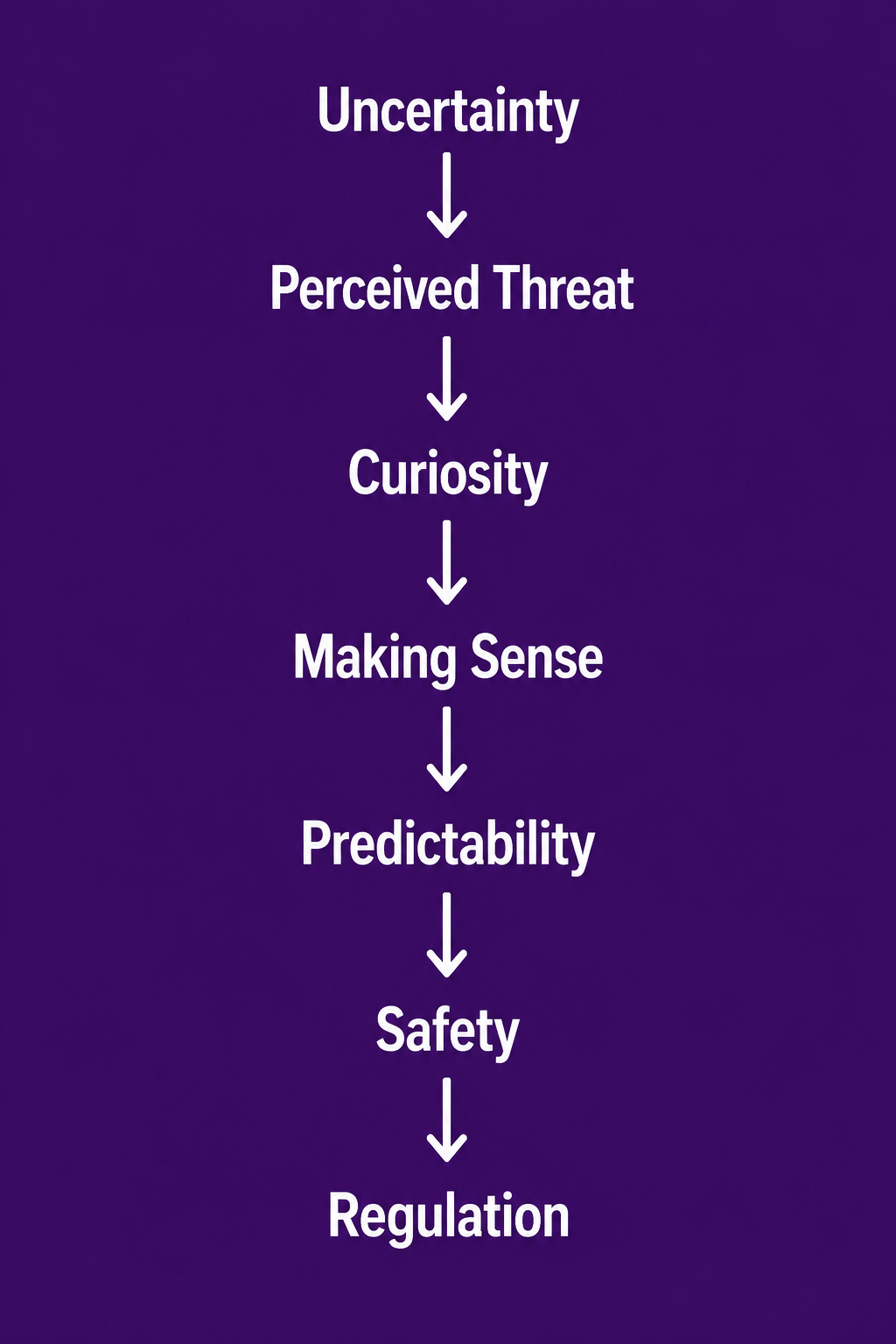
In my experience, the process often looks something like this:
This certainly won't resonate with everyone, but it is a pattern I have recognised repeatedly in myself and many of the neurodivergent people I have worked alongside. When uncertainty increases, curiosity often isn't simply an intellectual exercise. It is the nervous system searching for enough information to make sense of what is happening. As understanding grows, predictability increases, threat reduces and regulation becomes more possible.
Making Sense of Experience
Sometimes the most significant therapeutic shift doesn't occur after learning a new coping strategy, but when something finally makes sense.
A client understands why they react so strongly in certain situations. Years of masking begin to make sense. Trauma is recognised as something that shaped the nervous system rather than something that simply happened in the past. What was once interpreted as a personal failing is understood as a common feature of neurodivergence. The emotions themselves often haven't changed, but the story around those emotions has. Over the years, I have seen people begin to heal from trauma not because they finally found the "right" coping strategy, but because they finally understood why their nervous system responded the way it did.
As understanding grows, self-criticism often begins to soften. Words I hear so often—"defective," "broken," "weird," "crazy," "too much," or "too sensitive"—gradually give way to a very different question:
"Given everything I've experienced, how could I have expected my nervous system to respond differently?"
That shift doesn't erase the pain, but it often begins to replace shame with self-compassion.
.
Curiosity Creates Compassion
One of the guiding principles of my work is that behaviour almost always makes more sense once we understand the context surrounding it. This applies equally across age groups. Behaviour rarely becomes easier to understand after judgement; it almost always becomes easier to understand after curiosity.
When we become curious, we begin asking different questions.
What happened?
What need was trying to be met?
What was this person's nervous system responding to?
What would make this behaviour understandable rather than inexplicable?
Those questions rarely excuse harmful behaviour, but they often explain it. Explanation creates opportunity for compassion, collaboration and meaningful change in a way that judgement rarely can.
Understanding Restores Dignity
The longer I do this work, the more I find myself returning to the same idea. I don't believe people are simply searching for answers. I think many of us are searching to make sense of our experiences because understanding restores dignity. In doing so, it also empowers us to move forward with greater self-compassion, confidence and choice.
When experiences make sense, people stop seeing themselves as broken. When behaviour makes sense, shame begins to loosen its grip, and when nervous systems make sense, self-compassion becomes possible.
Over time, I have realised that I am not really searching for patterns. I am searching for meaning.
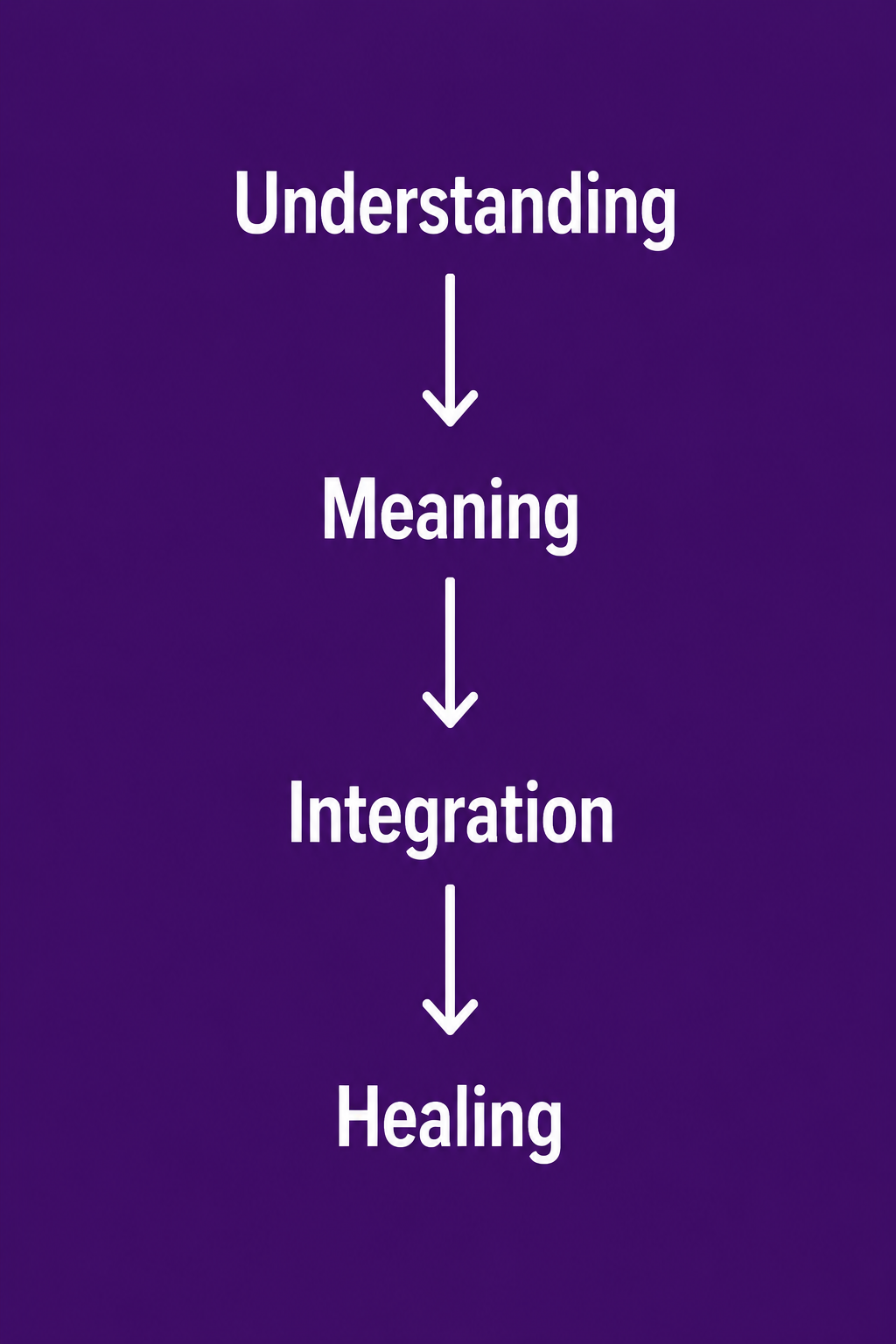
Patterns become meaning. Meaning becomes compassion. Compassion becomes dignity.
For many of the neurodivergent people I have worked with—and for me—understanding is not simply interesting.
It is regulating.
Meaning Before Healing
Many therapeutic approaches understandably begin with emotional processing. Among the neurodivergent clients I have worked with, I have noticed some people whose first instinct is to make sense of an experience before they can fully process how they feel about it. For some people, this reflects what is often described as top-down processing, where making sense of an experience becomes the pathway to safely experiencing the emotions connected to it. This isn't because they are avoiding emotion. Rather, understanding often creates the safety needed to experience those emotions without becoming overwhelmed by them.
In my experience, curiosity frequently opens the door that judgement keeps firmly closed.
Distress vs Defiance
Looking Beyond Behaviour
One of the most significant shifts in my own thinking has been learning to look beyond assumptions of defiance and ask whether distress may be present instead. This is not to suggest that every behaviour is caused by distress. However, I do believe we are often quicker to assume defiance than to consider what might be happening underneath.
Many neurodivergent people spend years being described as oppositional, resistant, avoidant, unmotivated or difficult when, underneath, they are overwhelmed, anxious, confused, exhausted or struggling to meet demands that exceed their current capacity.
From the outside, distress and defiance can sometimes look remarkably similar. Both may involve refusal, emotional reactions, withdrawal, avoidance or saying no. The difference lies not in the behaviour itself, but in what is happening underneath.
A Lesson I'll Never Forget
I didn't arrive at this idea through theory alone. I watched it happen.
As a teacher, I remember working with an autistic teenager who was frequently described as difficult, defiant and resistant. He was intelligent, creative and capable, yet much of the conversation surrounding him focused on behavioural incidents, missed expectations and his perceived inability to socially adapt to the world around him. After he completed a project particularly well, I sent a positive note home to his mother. She called me in tears.
Her response was simple:
"No one ever sends those."
What she usually received were reports about everything that had gone wrong.
That conversation has stayed with me ever since. It reminded me how easily behaviour can become the entire story. A young person can become so strongly associated with their difficulties that their strengths, efforts and successes gradually disappear from view. Behaviour had become so important that people had stopped seeing the human being underneath it.
Curiosity Before Correction
When distress is repeatedly interpreted as defiance, support can unintentionally become focused on increasing compliance rather than understanding what is driving the response in the first place. This is one of the reasons curiosity sits at the heart of my work. Some of the most important conversations begin when we stop asking:
"What consequence should follow this behaviour?"
and instead ask:
"What is making this difficult right now?"
Those two questions may appear similar, but they lead us in very different directions. One begins with the assumption that the behaviour itself is the problem. The other begins with the possibility that the behaviour may be communicating something important. In my experience, it is often that second question that opens the door to genuine understanding.
The Cost of Chronic Understanding
The Hidden Cost of Being Misunderstood
I think one of the most overlooked aspects of neurodivergence is the cumulative impact of being misunderstood. Not once or twice, and not only during particularly difficult periods, but repeatedly over years or even decades.
Many neurodivergent people grow up receiving messages that they are lazy, dramatic, too sensitive, disorganised, difficult, immature or simply not trying hard enough. Even when these messages are not stated directly, they are often implied through repeated corrections, criticism, exclusion or the persistent feeling that everybody else seems to have access to a rulebook that they somehow missed.
Over time, those messages can become internalised. People begin to question themselves, doubt their own experiences and assume their struggles are personal failings rather than understandable responses to environments that may not be meeting their needs.
Adapting to Survive
People naturally adapt in whatever ways they can. Some become experts at masking. Others become chronic people-pleasers, perfectionists or relentless over-achievers. Some withdraw altogether. Many push themselves far beyond sustainable limits in an effort to cope, gradually becoming disconnected from their own needs, limits and identity.
Ironically, these adaptations often appear successful from the outside. Friends, teachers, employers and even health professionals may see someone who is coping well, while the enormous effort required to maintain that appearance remains invisible.
The Loss of Self-Trust
The cost of chronic misunderstanding is not simply emotional. It can shape identity, self-worth, relationships, confidence and, perhaps most significantly, a person's ability to trust themselves.
After years of having experiences questioned, minimised or misunderstood, many people begin to second-guess their own thoughts, emotions and needs. They learn to look to others to determine whether their reactions are reasonable, whether their needs are valid or whether they are simply "overreacting" again.
Over time, it can become easier to trust someone else's interpretation of your experience than your own.
Feeling Understood
One of the most powerful things I have witnessed is what happens when someone finally feels understood. It is not simply that someone has listened. It is the experience of having your reality recognised without judgement, dismissal or the expectation that you should be different.
For many people, that moment is far more significant than others realise. It is often the beginning of something they thought they had lost: the ability to trust their own experiences again.
The Impact of Late Diagnosis: The Invisible Cost of Being Missed
The Story We Were Told
For me, one of the most confronting aspects of late diagnosis was realising how much of my life had been shaped by a story that was never true.
I spent years believing the wrong story about myself.
I absorbed messages about who I should be, how I should behave and what I needed to change in order to be accepted. Over time, those messages became so familiar that I stopped questioning them. It became easier to believe that something was wrong with me than to consider that the explanation itself might be wrong.
Most, if not all, late-diagnosed neurodivergent adults carry some degree of trauma—not because neurodivergence itself is inherently traumatic, but because of what can happen when a person spends years navigating a world that repeatedly misunderstands, invalidates or overlooks their needs.
Many people reach adulthood having spent decades masking distress, suppressing needs, questioning their own experiences and trying to become someone they were never meant to be. Over time, these experiences can leave deep and lasting impacts on a person's nervous system, sense of identity and relationship with themselves.
This is one of the reasons late diagnosis can feel so emotionally complex. For many late-diagnosed neurodivergent adults, diagnosis is not simply the discovery of something new. It is the re-examination of a lifetime of experiences through an entirely different lens. Experiences that were once interpreted as personal failings can suddenly begin to make sense in a way they never did before.
Burnout, overwhelm, chronic exhaustion, difficulties with relationships, the effort required to mask and the constant feeling of being out of step with others often take on a very different meaning when viewed through a neurodivergent lens. Many people spend decades believing they are lazy, broken, failing, too sensitive, too emotional, too intense or simply not trying hard enough. When diagnosis arrives, it can challenge those beliefs in ways that are both liberating and deeply confronting.
Searching for Answers
For many women in particular, the journey towards diagnosis is rarely straightforward.
Some spend years searching for answers and accumulating diagnoses that only partially explain their experiences. Anxiety disorders, depression, obsessive-compulsive disorder, eating disorders, personality disorders and trauma-related diagnoses may all become part of the story.
Sometimes these diagnoses reflect genuine co-occurring experiences. Sometimes they represent attempts to understand neurodivergent traits through frameworks that do not fully fit. People can spend years trying to understand themselves through explanations that never quite account for the whole picture. Each new explanation can reinforce the belief that the problem lies within the individual rather than in the absence of an explanation that genuinely fits.
One of the more complex aspects of late diagnosis is realising how many adaptations have become invisible.
When masking begins in childhood and continues for decades, it can stop feeling like something you do and start feeling like who you are. Many people become so skilled at monitoring themselves, suppressing needs, anticipating the expectations of others and adjusting their behaviour to fit in that they no longer recognise these processes as adaptations. They simply become normal.
This can make the process of self-discovery particularly challenging. There are people in their thirties, forties, fifties and beyond who are only just beginning to ask questions about who they actually are beneath the layers of adaptation.
Looking Back
Most, if not all, late-diagnosed neurodivergent adults carry some degree of regret. Like many people, I found myself looking back at periods of my life and wondering how different things may have been with earlier understanding and support.I had wanted to become a veterinarian for as long as I could remember. Yet by the time I reached university, I was already struggling in ways I did not understand.
Throughout Years 11 and 12, I regularly missed the first half of the school day because I was lying awake until three or four o'clock in the morning, unable to sleep. Despite this, I somehow managed to achieve the scores required to gain entry to The University of Melbourne, largely through an ability to absorb enormous amounts of information at the last minute and cram for exams.
From the outside, that looked like success. What nobody could see was how difficult it had been to get there.
When I arrived at university, I found myself spending chemistry practicums planning pub crawls with my lab partner rather than paying attention to the experiment in front of me. I spent huge amounts of energy worrying about how I presented myself, acutely aware that I was one of the few students who had not come from a private school background. I would fall asleep on the grass between classes, regularly miss tutorials and often tune out completely during lectures, absorbing very little of what was being taught. At one point, I was asked to leave a mathematics lecture held in a 200-seat auditorium after laughing loudly partway through. I can still remember the long walk down the steps towards the exit and the looks of disapproval from the serious science students around me. At the time, however, all I could see was someone who was letting people down.
Looking back now, I can see a very different story. I can see that I was constantly seeking stimulation and dopamine in an attempt to regulate. I can see that I was masking harder and harder, trying to appear as though I was coping whilst becoming increasingly overwhelmed behind the scenes.
I do not see laziness.
I do not see lack of effort.
I do not see wasted potential.
I see unsupported ADHD.
I see delayed sleep phase disorder.
I see a nervous system struggling to meet demands without the understanding, accommodations or support it needed.
I see unsupported neurodivergence.
That realisation can be incredibly validating, but it can also bring profound sadness for the opportunities, support and understanding that may have changed the course of a person's life.
Relief, Grief and Anger
For me, one of the most unexpected emotions was anger.
Not simple anger, but a complicated mixture of grief, confusion, validation, regret and injustice that was often difficult to untangle.Part of that anger came from realising how much responsibility had ultimately fallen on me. I was the one who had to discover I was autistic. I was the one who had to pursue answers. I was the one who had to make sense of experiences that had shaped my life for decades.
At the same time, I found myself looking around and wondering how so many people had missed what now seemed obvious. When I shared my diagnoses with friends, many were more surprised by the autism than the ADHD. Some responded with variations of, "Well, of course you are." That reaction was deeply confronting. It felt as though other people had been seeing something entirely different to the person I believed I was presenting to the world.
For many people, late diagnosis can create an uncomfortable tension between relief and anger. Relief that there is finally an explanation, and anger that the explanation took so long to arrive. There can be anger at missed opportunities, years spent trying to solve the wrong problem, outdated diagnostic frameworks and support systems that continue to lag behind the realities of neurodivergent lives. There can also be anger at the expectation that people should simply absorb a life-changing diagnosis and move on, despite the profound identity upheaval that often follows.
When Diagnosis Feels Unsafe
Diagnosis is not experienced as positive news by everybody.
For some people, it brings enormous relief. Some find having a label deeply validating and cathartic, finally providing language for experiences that may never have fully made sense before. Others dislike labels altogether and experience diagnosis as confronting, unsettling or difficult to integrate into their sense of self.
For some people, diagnosis can also feel profoundly unsafe. A diagnosis may bring clarity, but it can create fears about being judged, treated differently, viewed as less capable or no longer being seen in the same way by the people around them. For those who have spent years working hard to mask their differences, diagnosis can feel less like an explanation and more like a potential threat to acceptance, belonging and identity.
A diagnosis does not arrive in a vacuum. It arrives within a society that continues to hold many misconceptions about neurodivergence. Some people worry they will be judged differently. Others fear they will be viewed as less capable, less competent or somehow less than they were the day before receiving their diagnosis. These fears are not unfounded. Many of us grew up with narrow and often inaccurate representations of autism and ADHD, leaving little understanding of the diversity that actually exists within neurodivergent communities.
Rebuilding Identity
For some people, diagnosis can create an identity earthquake. The explanation may finally fit, yet everything feels uncertain at the same time. Long-held beliefs about who you are begin to shift. Relationships, memories, strengths, difficulties and life experiences are suddenly viewed through an entirely different lens.
A diagnosis itself may take only a few hours. Making sense of what it means can take years.
Receiving a diagnosis may answer important questions, but it rarely resolves the grief, regret, identity reconstruction and trauma that can accompany decades of misunderstanding.
In many ways, diagnosis is not the end of the journey.
For many people, it is the first time they begin to understand who they have been all along.
Systems Fatigue: The Trauma of Constant Burden
The Cost of Constant Adaptation
Exhaustion is an old friend of mine.
This page is not really about exhaustion.
It is about power. More specifically, it is about autonomy, and what happens when people repeatedly lose it.
The exhaustion is the symptom. The trauma is often the consequence. The deeper issue is the gradual erosion of autonomy that can occur when people are repeatedly forced to engage with systems that do not work for their brains.
When I use the word systems, I am referring to the structures, organisations and services that people interact with throughout their lives. This may include schools, healthcare providers, disability services, workplaces, government agencies, utility providers, financial institutions, legal and judicial systems, housing services and other support systems.
Systems fatigue is not unique to healthcare, education or disability services. Similar patterns can emerge wherever people repeatedly encounter environments that prioritise standardisation, control or efficiency over accessibility, autonomy and genuine collaboration. Many of these systems were designed by neurotypical thinkers for neurotypical users. The assumptions built into them often reflect neurotypical communication styles, processing speeds, organisational skills and ways of interacting with the world.
For those who fit those assumptions, the barriers may be largely invisible. For others, navigating systems requires a significant amount of additional effort, planning, adaptation and, over time, burden. That burden is rarely created by a single interaction. It accumulates through countless small demands: another form to complete, another phone call to make, another professional to update, another explanation to give, another piece of evidence to provide and another inaccessible process to navigate. Individually, these demands may seem manageable. Collectively, they can become exhausting. When they occur repeatedly over months or years, they can become something more: they can become traumatising.
I have personally become increasingly aware of the difference between systems that describe themselves as inclusive and systems that are genuinely accessible. Many organisations now speak the language of inclusion, diversity and accessibility. Whilst these intentions may be genuine, my experience has been that true inclusion requires far more than good intentions. A system is not inclusive simply because it says it is. It is inclusive when people with different communication styles, processing needs, sensory profiles and support requirements can successfully access it without experiencing unnecessary barriers.
I recently encountered this myself when trying to contact a large service provider. On previous occasions, I had navigated their phone system without difficulty using structured menu options. Without warning, those options had been removed. Instead, callers were required to verbally explain the reason for their call to an AI system so they could be directed appropriately. On the surface, this may seem like a minor inconvenience. For me, it was anything but.
As someone with delayed auditory processing, ADHD and a brain that often has hundreds of thoughts competing for attention simultaneously, being asked to immediately formulate a concise verbal summary of my problem whilst under pressure was incredibly difficult. The system assumed that everybody could quickly organise their thoughts, verbally communicate them and tolerate the demands of a phone interaction. That assumption was wrong.
After multiple attempts, I became increasingly dysregulated, frustrated and overwhelmed. The issue was never my capability. The issue was the mismatch between what the system required and how my brain functions.
Unfortunately, experiences like this are not uncommon. What often goes unrecognised is the impact these experiences can have on a person's confidence, self-esteem and willingness to remain autonomous. For me, experiences like this can leave me questioning myself, despite knowing intellectually that the problem is not a lack of intelligence or capability.
The difference is not intelligence.
The difference is accessibility.
When these same systems previously offered structured options, I could navigate them successfully. When those options disappeared and were replaced with communication demands that did not align with how my brain processes information, my ability to access the service changed with them. That is not a personal failure.
When systems repeatedly require people to communicate, process information or advocate for themselves in ways that do not align with their needs, the responsibility for adaptation falls back onto the individual.
The person is expected to change.
The system remains largely unchanged.
Over time, this creates more than fatigue. It creates a gradual loss of autonomy as people learn that access often depends on their ability to function in ways that do not align with how their brains work.
In many ways, systems fatigue is simply environmental mismatch at a structural level. It is also where heavy masking often begins. Many neurodivergent people become highly skilled at hiding confusion, frustration, overwhelm and uncertainty because previous experiences have taught them that these responses may be judged negatively. Over time, appearing capable can become more important than feeling supported. Asking for help may begin to feel unsafe, whilst pushing harder and compensating for difficulties becomes the default response. Although these strategies can be effective in the short term, they often come at a significant personal cost. What is often interpreted as coping may actually be adaptation, masking or survival.
This is also where systems trauma begins.
Repeated experiences of feeling unheard, dismissed, misunderstood or unable to successfully navigate important systems can leave lasting impacts. People may begin approaching appointments, meetings, phone calls or administrative tasks with anxiety long before anything has happened, not because they are unwilling to engage, but because previous experiences have taught them that engagement may come at a cost.
Healthcare settings are one example. Emergency departments are often fast-paced, unpredictable, sensory-intense environments that place significant communication demands on people at precisely the time they may be least able to meet them. Yet there is often limited recognition of how neurodivergence can influence communication, information processing, sensory tolerance, interoception and emotional regulation under these conditions.
As somebody with severe asthma, I have experienced this repeatedly throughout my life. Emergency departments can be overwhelming from a sensory perspective, but what I find particularly challenging is how heavily they often rely on assumptions about how distress should look and how symptoms should be communicated.
For example, pain is frequently assessed using numerical rating scales, yet poor interoception can make it difficult to accurately quantify internal experiences in ways that others expect. Likewise, many neurodivergent people develop highly independent or stoic coping styles after years of managing difficulties on their own. The result is that significant distress may not always look the way healthcare professionals expect it to look.
When systems rely heavily on standardised assumptions about communication, pain, distress or emotional expression, some people can find themselves feeling misunderstood at precisely the moments they most need support.
This is not unique to my experience. I have worked alongside many neurodivergent people who describe medical experiences as deeply distressing, not because of the treatment itself, but because they felt unheard, misinterpreted or unable to effectively communicate their needs whilst under significant pressure.
When the Environment Becomes the Barrier
My own experiences in hospital have reinforced this for me. Having spent much of my life attending emergency departments with severe asthma, I have become increasingly aware of how little attention is often given to the sensory environment itself. The constant beeping of monitors, overlapping conversations, people calling out, bright lighting, clinical smells, repeated interruptions and regular physical examinations can create an environment that is extraordinarily difficult for many neurodivergent nervous systems to tolerate. For many people, it is almost impossible to tune out.
The sensory environment is only part of the picture. Medical care also often involves frequent examinations, unexpected touch, repeated questions, changing staff and significant uncertainty, all occurring whilst people are expected to process information and make important decisions. Individually, each of these demands may seem entirely reasonable. Together, they can place an enormous burden on a nervous system that is already under considerable stress.
The Weight We Carry
Many people are not simply carrying the practical burden of navigating systems. They are carrying the emotional burden of previous interactions with those systems and memories of not being believed. Of having to prove their needs. Of being told to try harder. Of having their difficulties interpreted as a lack of effort rather than a mismatch between themselves and the system. Of having genuine questions mistaken for a lack of understanding.
I have lost count of the number of times I have asked "why?" and had people assume I was confused. In reality, I understood perfectly well what they were saying. I was asking because their explanation did not make sense. The assumption that a person is struggling to understand can be just as damaging as the assumption that they are not trying hard enough.
Both communicate the same underlying message:
The problem is you.
When repeated often enough, many people eventually start believing it.
One of the things I have come to appreciate is that systems fatigue rarely develops because of a single difficult interaction.
It develops through accumulation.
Another form to complete.
Another phone call to make.
Another appointment to attend.
Another professional to update.
Another report to explain.
Another piece of evidence to provide.
Another system to learn.
Individually, each demand may appear manageable. Together, they create a cognitive and emotional load that can become exhausting, particularly for people whose nervous systems are already working harder simply to navigate the world.
This cumulative burden is rarely recognised because much of the work remains invisible. It is the planning, translating, organising, remembering, advocating, anticipating and recovering that happens behind the scenes. Over time, that burden can erode confidence, reduce autonomy and leave people questioning their own capability, despite the problem often lying within the system rather than the individual.
It is rarely a single interaction that becomes traumatising. More often, it is the cumulative burden of navigating systems that repeatedly require people to adapt, explain, justify and advocate for themselves. Over time, the weight of that burden can leave lasting psychological scars, changing not only how people engage with systems, but how safe they feel asking for help at all.
This is one of the reasons I believe support should aim not only to build capacity, but also to reduce unnecessary burden wherever possible.
Whilst no single professional can remove every barrier, meaningful support can come from helping people carry less. It can come from reducing the amount of translation required, recognising the effort that has already been expended and helping people develop the confidence, understanding and support needed to navigate systems more effectively themselves. Sometimes support means building new skills. Sometimes it means advocating, simplifying, translating or sharing the load until a person is able to regain confidence in navigating systems independently.
At the same time, I believe the broader goal should be bigger than individual adaptation.
True inclusion requires systems themselves to evolve. It requires organisations, schools, workplaces and service providers to recognise that accessibility is not achieved by asking people to work harder, but by creating environments that accommodate a wider range of human needs.
Sometimes the most valuable support is not asking people to do more.
Sometimes it is helping them carry less.
Why Safety Changes Everything
Nervous System Safety
One of the most significant shifts in my understanding of neurodivergence has been recognising the profound impact that safety has on a person's ability to function, learn, connect and thrive. Physical safety is fundamental to human survival. Far less attention has been given, until relatively recently, to the importance of nervous system safety, particularly for neurodivergent people.
Nervous system safety extends beyond physical protection. It includes the experience of feeling accepted, understood, respected and able to exist without constantly anticipating judgement, criticism, rejection or misunderstanding. It also includes protection from emotional harm and environments that create ongoing sensory overwhelm.
I often see people being judged according to how they function when they feel least safe. Children are assessed when they are overwhelmed. Teenagers are criticised when they are dysregulated. Adults are often evaluated during periods of burnout, exhaustion or significant stress. Yet these moments rarely reflect a person's full capacity.
A nervous system focused on survival has fewer resources available for learning, emotional regulation, social connection, problem-solving and growth. This is not a reflection of character, intelligence or motivation. It is simply how nervous systems operate under stress, particularly when that stress has been present for years or even decades.
Over time, I have come to understand that many neurodivergent people spend so much of their lives adapting to environments that do not feel safe that the adaptations themselves can become invisible.
Many become so accustomed to masking, monitoring themselves and protecting the parts of themselves that feel different that genuine vulnerability begins to feel unsafe.
Walls are built for good reasons. They protect against judgement, rejection, criticism and misunderstanding. Yet those same walls can create another kind of loneliness. The longing to be understood often remains, but very few people are allowed close enough to see what is underneath. Many neurodivergent people find themselves caught in this painful contradiction: desperately wanting to be known and understood whilst simultaneously feeling unable to fully reveal the parts of themselves they most want others to understand. The result can be a profound sense of disconnection. Not because meaningful connection is unwanted, but because years of adaptation have taught the nervous system that being fully seen may not be safe.
Safety Makes Authenticity Possible
Safety and masking are deeply intertwined. For many neurodivergent people, masking begins so early in life that it can be difficult to distinguish where the mask ends and the person begins. It is often spoken about as though it is simply a social skill, but my experience has been that masking is far more complex than that.
At its core, masking is a protective strategy.
It develops in response to environments where being authentic feels unsafe, where differences are noticed and judged, or where acceptance appears conditional upon behaving in ways that are considered more acceptable to others.
Many strong maskers become exceptionally skilled observers of human behaviour. They learn how to read a room, anticipate reactions, adjust their presentation and perform versions of themselves that are more likely to be accepted. In many ways, I believe some of the strongest maskers would make exceptional actors. The difference is that actors usually get to leave the stage. For many neurodivergent people, the performance continues for years or even decades.
Research suggests that intellectual strengths, strong language skills and hyperverbal communication can make masking particularly effective. Whilst these abilities can create opportunities, they can also contribute to people being overlooked, misunderstood or diagnosed much later in life because the effort involved remains largely invisible. This is one of the reasons I sometimes struggle when people suggest that somebody should simply "unmask". To me, that can be a little like asking someone to stand naked in the middle of Times Square.
Masking is not usually abandoned because somebody decides to stop. It begins to soften when safety is present.
Safety creates the conditions that make authenticity possible.
Safety also plays an important role in nervous system regulation.
All humans engage in activities that help them regulate stress, emotions and nervous system arousal, although many people rarely think about these processes consciously. Some regulate through movement, hobbies, exercise, spending time with loved ones, watching television or interacting with animals.
For many neurodivergent people, however, regulation often requires more deliberate attention. Nervous systems that are highly sensitive to sensory information, social demands, uncertainty or environmental stressors may require more frequent opportunities to regulate throughout the day. This is why self-regulatory behaviours, including stimming, can be so important. These behaviours are often misunderstood because they may appear unusual to others. Yet many serve an important nervous system function. The challenge is that people are often discouraged from using the very strategies that help them feel regulated, particularly when those strategies are viewed as socially unacceptable or "different". Regulation can also look very different from one person to the next. Some people regulate best through connection and co-regulation with trusted people. Others regulate best through solitude, quiet environments or reduced demands. There is no single right way to regulate. The important question is not whether a strategy looks typical, but whether it helps the person feel safer, calmer and more able to engage with the world around them.
Safety allows people to express needs without immediately preparing for criticism. It creates space for honest communication without anticipating judgement, and for choices that align more closely with personal values than external expectations.
Authenticity is not about revealing everything to everyone. Nor is it about abandoning every adaptation that has helped a person navigate the world. For me, authenticity is about increasing alignment between how a person experiences themselves internally and how they are able to exist externally. It is the experience of needing less performance, less self-monitoring and less protection. When people feel genuinely safe, many discover that they no longer need to spend quite so much energy managing how they are perceived. They become more curious, more spontaneous and more connected to the parts of themselves that have often been hidden away for protection.
In my experience, safety is not what happens after authenticity.
Safety is what makes authenticity possible in the first place.
I have repeatedly experienced, both professionally and personally, what happens when safety is present. People become more willing to take risks, ask questions and express needs. They recover from mistakes more easily and spend less energy monitoring themselves. Instead of focusing on survival, they are able to engage more fully with learning, relationships and the world around them.
Importantly, safety should not be confused with the absence of expectations. People can still be challenged, encouraged to grow and supported to develop new skills within environments that feel safe. In fact, meaningful growth is often more likely to occur when people feel safe enough to experiment, make mistakes and learn without fear of judgement.
Too often, support focuses on changing behaviour without adequately considering whether the environment itself feels safe for the person expected to function within it. My experience has been that when safety increases, many of the behaviours people are most concerned about begin to make more sense. Sometimes they reduce. Sometimes they change. Sometimes they reveal needs that were hidden underneath them all along.
Safety is not optional.
It is a cornerstone of human psychology.
When people feel safe, they are far more likely to access the parts of themselves that allow them to learn, connect, adapt and grow.
When people can access safety, they are far more able to become who they want and need to be.
Autonomy, Dignity & Collaboration
Lived Experience Matters
Too often, support becomes something that is done to people rather than with them.
Professionals may have expertise in particular fields, but every person remains the expert in their own lived experience. Collaboration means recognising that meaningful understanding is more likely to emerge when different perspectives are welcomed, respected and explored with curiosity. It acknowledges that whilst professional knowledge is valuable, it is only one part of the picture.
This feels particularly important within neurodivergent communities. Many neurodivergent people spend years being observed, assessed, interpreted and spoken about by others. In the process, they may also be misunderstood, misrepresented or have assumptions made about them based on behaviour rather than communication. Their experiences are often filtered through the perspectives of teachers, parents, professionals, employers or support systems, sometimes with very little opportunity to contribute their own understanding of what is happening. Over time, this can create the sense that other people know more about your experience than you do.
Yet lived experience matters. Not because it replaces professional knowledge, but because it provides a perspective that no assessment, report or observation can fully capture. A professional may understand a diagnosis, a framework or a body of research. That does not automatically mean they understand the person sitting in front of them. The richest understanding emerges when professional knowledge and lived experience inform one another, rather than one being given greater authority than the other.
Understanding Is a Shared Responsibility
Communication differences are often framed as though they exist entirely within the neurodivergent person. The expectation is frequently that they should learn to communicate more effectively, adapt more successfully and become easier for others to understand. I see communication differently. Meaningful communication requires effort, curiosity and adaptation from both people. I do not believe neurodivergent people should be left carrying the entire burden of translation. When one person is expected to do all of the adapting whilst the other makes little effort to understand their perspective, the relationship quickly becomes unequal. Genuine communication requires a willingness from both people to move towards one another.
For me, curiosity is one of the clearest expressions of respect. It communicates that another person's thoughts, feelings and experiences are worth understanding rather than assuming. Curiosity creates space for learning, flexibility and genuine collaboration, whilst assumptions tend to close those possibilities down before they have even been explored.
Compliance Is Not the Same as Wellbeing
Autonomy and dignity matter because they acknowledge a person's right to have a voice in their own life. This includes the right to express preferences, communicate needs, set boundaries, disagree respectfully and contribute to decisions that affect them. It also means recognising that support should not be measured solely by compliance.
A person can appear cooperative whilst experiencing significant distress. They can meet expectations whilst paying an enormous internal cost. Looking compliant tells us very little about whether somebody feels safe, understood or genuinely supported. When people feel heard, respected and included, they are often more willing to engage, explore new perspectives and participate in meaningful change—not because somebody has convinced them to, but because they feel safe enough to contribute their own voice.
What Compliance Can Hide
I was reminded of this during my own hospital admission after breaking and dislocating two fingers. A surgeon entered the room, briefly informed me that I would be staying overnight and then immediately began handling my injured hand before asking me to make a fist. He did not ask permission to touch my hand or explain why he needed to examine it or ask me to make a fist. From my perspective, it simply felt like somebody was asking me to do something that would significantly increase my pain. My immediate thought was, "Why would I do that?" I attempted to, but couldn't. His response was simply, "Come on, you can do better than that."
Outwardly, I complied. Inwardly, however, my nervous system reacted very differently. I felt an immediate surge of anger. My first instinct was that I wanted to swear at him and tell him he had no idea what I was going through. To me, his response felt like somebody in a position of considerable authority telling me what my own body was capable of, whilst showing very little appreciation that my perspective of the situation was entirely different from his. He knew what was happening. I didn't. He understood the injury, the assessment and the process. I was still trying to orient myself, process what was happening and understand why I was being asked to do something that felt so painful. The interaction was never between two people with equal power. He was the surgeon. I was the patient—injured, vulnerable and entirely dependent on his expertise.
Despite everything happening internally, I forced myself to remain compliant. Decades of navigating authority figures had taught me that openly reacting to somebody in a position of power was unlikely to improve the situation. Instead, I did what I have learned to do in countless similar situations: I suppressed my reaction, complied with the request and carried the emotional cost privately.
Nothing about my behaviour communicated how strongly my nervous system had reacted. From the outside, the interaction appeared straightforward. The request was made, the patient complied and the assessment continued. What remained invisible was the internal effort it took to override my instinctive response, along with the loss of psychological safety that accompanied it.
Experiences like this have reinforced for me that compliance is not the same as comfort, understanding or felt safety. A person may appear cooperative whilst internally experiencing fear, frustration, anger or a powerful drive to regain autonomy. If we judge our interactions solely by whether somebody complies, we may completely miss what the interaction actually cost them
Partnership, Not Process
For me, collaboration is ultimately about creating space for different forms of knowledge and experience to contribute to the conversation. It is the belief that people should be listened to rather than spoken for, understood rather than assumed, and included rather than managed.
When people are treated with autonomy, dignity and genuine curiosity, support becomes something very different. It becomes a partnership rather than a process and, in my experience, that is where some of the most meaningful change occurs.
Understanding Goes Both Ways
Communication Is More Than Words
Human communication is extraordinarily complex. We rarely communicate through words alone. Facial expressions, body language, tone of voice, timing, eye contact, gestures, previous experiences and context all contribute to how meaning is created between people. Most conversations involve far more than the literal words that are spoken.
I sometimes wonder whether this is one of the reasons many autistic people become such careful observers of human behaviour. When communication does not come intuitively, many of us begin consciously studying it instead. We become people-watchers. We notice subtle changes in facial expression, body language, tone of voice and behaviour because we are constantly trying to understand what another person is communicating with their whole self, not simply with their words.
Perhaps this is one of the reasons I have always placed so much value on actions. Words matter, but they are only one part of communication. I have learned to look for consistency between what people say, what they do and how they behave over time.
Researchers have increasingly described this through what is known as the Double Empathy Theory. Rather than viewing communication difficulties as existing solely within autistic people, this perspective suggests that misunderstandings often arise because autistic and non-autistic people experience and interpret the world differently. Communication difficulties are often something that emerges between people rather than existing entirely within one individual.
The Burden of Translation
Over time, many neurodivergent people become fluent in neurotypical communication. They learn to monitor their words, soften their directness, suppress literal interpretations, explain themselves more carefully and anticipate how they might be misunderstood. Therapies, educational approaches and broader social expectations have often reinforced the idea that successful communication depends primarily on the neurodivergent person adapting.
The burden of achieving mutual understanding has fallen disproportionately on neurodivergent people.
Far less attention has traditionally been given to helping neurotypical people understand neurodivergent communication styles or recognise their own contribution to misunderstanding. I believe communication is a shared process, and genuine understanding requires curiosity, flexibility and adaptation from both people.
Literal Doesn't Mean Lacking Intelligence
One of my earliest memories of this happened in Year 7. We were told to "bring a plate" for a lunchtime celebration, so I did. I brought a plate. When the teacher saw me, she loudly asked, "Where's the food? Did you think you were just going to get a free lunch?"
I remember feeling deeply confused and embarrassed as my classmates stopped and stared at me. I also remember feeling judged. In that moment, the assumption wasn't simply that I had misunderstood the instruction. The assumption was that I had deliberately come without contributing, that I was trying to get a free meal at everyone else's expense. Nobody had said to bring a plate of food. Two additional words would have completely changed my understanding.
Looking back, I can see that this was one of the first times I became acutely aware that I processed language differently from many of the people around me. More importantly, I began learning that thinking differently could result in embarrassment, judgement or being singled out in front of other people. Experiences like this may seem small in isolation, but over time they shape how safe it feels to ask questions, admit confusion or interpret language literally. In many ways, they become part of the foundations upon which masking is built.
When Context Disappears
Text messages, emails and social media remove many of the cues that humans naturally rely upon to understand one another. Tone of voice disappears. Facial expressions disappear. Timing becomes ambiguous. Pauses can mean almost anything. For many neurodivergent people, it can feel like the Wild West, where misunderstanding can be lurking around every corner. The usual signposts that help us navigate communication have suddenly disappeared, leaving us to reconstruct another person's meaning from remarkably little information.
The less information available, the more interpretation is required. For many of us, that means working significantly harder to infer another person's intentions from a much smaller amount of information. Sometimes those interpretations are accurate. Sometimes they are not. Either way, the cognitive effort involved can be considerable.
For many strong maskers, asking for clarification does not always feel safe. Years of adapting can teach us that admitting confusion risks appearing unintelligent or socially incompetent. Rather than checking our understanding, many of us quietly guess instead. Sometimes we guess correctly. Sometimes we don't.
Checking In Before Checking Out
One of the most valuable communication skills I learned during counselling training was the importance of checking in. Rather than assuming we have understood another person correctly, we pause and check our understanding before responding. It is a simple practice, but one that can prevent countless misunderstandings.
I believe this habit has value far beyond counselling. Imagine how many conflicts might be avoided if we became more comfortable saying:
"Can I check I've understood what you meant?"
"When you said that, this is what I understood. Is that what you meant?"
"I think I may have interpreted that differently. Can you explain it another way?"
"Can you tell me more about what you meant?"
Checking in is not a sign that someone is unintelligent, socially awkward or struggling to understand. In my view, it is one of the clearest signs that someone values accuracy over assumption. It communicates curiosity, respect and a genuine desire to understand another person's perspective.
I often wonder how many misunderstandings could be prevented if checking in became a more ordinary part of everyday communication.
What I Wish More Professionals Understood
Throughout my career, I have worked from multiple perspectives: as a teacher, as a counsellor, as a neurodivergent support professional and as a neurodivergent person.
Each perspective has taught me something different, but there are a handful of observations that I find myself returning to again and again.
Lessons That Continue to Shape My Practice
I wish more professionals felt comfortable becoming curious before becoming corrective.
Behaviour makes far more sense when viewed in context. I rarely find myself wondering what is wrong with a person. I am much more interested in understanding what is happening around them, what demands are being placed upon them, what supports may be missing and whether their behaviour might be communicating something important. Over the years, I have become increasingly aware of how often neurodivergent people are viewed through lenses of behaviour, compliance, performance or productivity. Whilst these things can provide useful information, they rarely tell the whole story.
I wish more professionals understood the cumulative impact of chronic misunderstanding.
Many neurodivergent people have spent years adapting to environments that were never designed with them in mind. By the time they arrive in our offices, classrooms or services, they may already be carrying significant shame, exhaustion, self-doubt and anxiety. What can sometimes look like resistance, avoidance, disengagement or a lack of motivation may have far more to do with previous experiences than a lack of willingness to participate.
I wish more professionals understood the responsibility that comes with holding power.
The words we write, the assumptions we make and the conclusions we draw can shape educational pathways, healthcare experiences, access to support and even family relationships. Every new professional, assessment or service can mean retelling deeply personal experiences in the hope that this time they will be understood.
I wish more professionals recognised how much vulnerability it takes to seek support.
Seeking support is rarely just about asking for help. For many neurodivergent individuals and families, it means continually revisiting struggles, advocating for needs and explaining experiences that have previously been dismissed, minimised or misunderstood. Every new professional, assessment or service can mean retelling deeply personal experiences in the hope that this time they will be understood.
I wish more professionals looked beyond communication differences.
Many neurodivergent people know exactly what they are experiencing whilst struggling to communicate it in ways that others immediately understand. This can become particularly difficult during periods of stress, sensory overwhelm, illness, pain or strong emotion. When communication breaks down under these conditions, it can be easy to assume the person lacks insight, is being uncooperative or does not understand what is happening. In reality, they may understand their experience extremely well and simply be struggling to communicate it in that moment. The challenge is not always understanding what is happening. Sometimes the challenge is communicating effectively whilst a nervous system is under significant pressure.
I wish more professionals understood that high achievement does not necessarily mean a person is coping.
Some of the individuals who appear the most capable on the surface may be carrying extraordinary levels of stress underneath. Success can hide struggle in much the same way that compliance can hide distress. When outcomes become the primary focus, it is easy to overlook the effort, exhaustion and adaptation required to achieve them.
I wish more professionals viewed the environment as part of the intervention.
Rather than asking how a person can better fit their environment, I believe we should also be asking how environments can better support the people within them. Sometimes relatively small changes to expectations, communication, sensory demands or flexibility can have a greater impact than expecting an individual to continually adapt.
I wish more professionals gave greater weight to lived experience.
Professional knowledge, research and clinical expertise are all important. However, I do not believe these forms of knowledge should replace the voices of the people actually living the experience. Some of the most important things I have learned about neurodivergence have come directly from neurodivergent people themselves. The people seeking support are not simply recipients of professional knowledge; they are active contributors to understanding, and their perspectives deserve to carry genuine weight.
I wish more professionals understood that consistency builds trust.
For many neurodivergent people, uncertainty is not simply uncomfortable; it can be profoundly dysregulating. Small acts of reliability, honesty and follow-through often have a far greater impact than we realise.
I wish more professionals understood that autonomy is not a reward to be earned.
Too often, opportunities for choice, independence and self-determination are offered only when someone demonstrates enough compliance. I believe autonomy is something we should be helping people build, not withholding until they meet our expectations.
I wish more professionals felt comfortable saying, "I don't know."
Curiosity and humility create space for learning. No single professional will ever fully understand another person's lived experience, and acknowledging this often strengthens rather than weakens trust.
I wish more professionals understood that support should reduce burden, not add to it.
When appointments, paperwork, phone calls and repeated explanations become overwhelming, the support system itself can become another source of stress. Good support should make life more manageable, not more complicated.
I wish more professionals recognised that not all meaningful progress can be easily measured.
Schools often rely on SMART goals, whilst systems such as the NDIS understandably require measurable outcomes to guide educational planning, funding and accountability. These frameworks have an important place, but they can also shape what we notice, what we prioritise and ultimately what we value. Sometimes progress looks like asking for help sooner, recovering more quickly from overwhelm, setting healthier boundaries or feeling safe enough to stop masking. These changes may not fit neatly into a goal, a progress report or a funding review. They may not produce dramatic behavioural changes or immediate measurable outcomes. Yet they can represent profound shifts in wellbeing, identity and quality of life. When we only value what can be measured, we risk overlooking some of the changes that matter most.
Perhaps more than anything else, I wish more professionals understood the power of helping someone feel genuinely seen.
Many neurodivergent people spend years feeling analysed, interpreted or spoken about. They become accustomed to having their experiences explained through frameworks created by others. Whilst these frameworks can be useful, they are never a substitute for listening.
In my experience, some of the most meaningful moments in support occur when a person feels understood rather than assessed, heard rather than interpreted, and accepted rather than corrected.
Sometimes the most valuable thing we can offer another human being is not an intervention, strategy or explanation.
It is the experience of feeling genuinely understood.
Because when people feel genuinely understood, there is often less masking, less explaining and more space to simply be themselves.